When parents start searching for a martial art for their child, or adults decide they want real self-defense skills, the same three names come up again and again: karate, taekwondo, and jiu-jitsu. All three are legitimate martial arts with dedicated communities and proven athletic traditions. But when the question is specifically karate vs. taekwondo vs. jiu-jitsu for self-defense, the answer is more nuanced than most people expect. Choosing between them comes down to how real-world confrontations actually unfold, your body type, your age, and what kind of training environment you want to be in every week. At Dragon Mu Sool, we teach Kuk Sool, a comprehensive Korean martial art that draws from many of the same roots as these popular styles, so we have a genuinely useful perspective on how they compare.
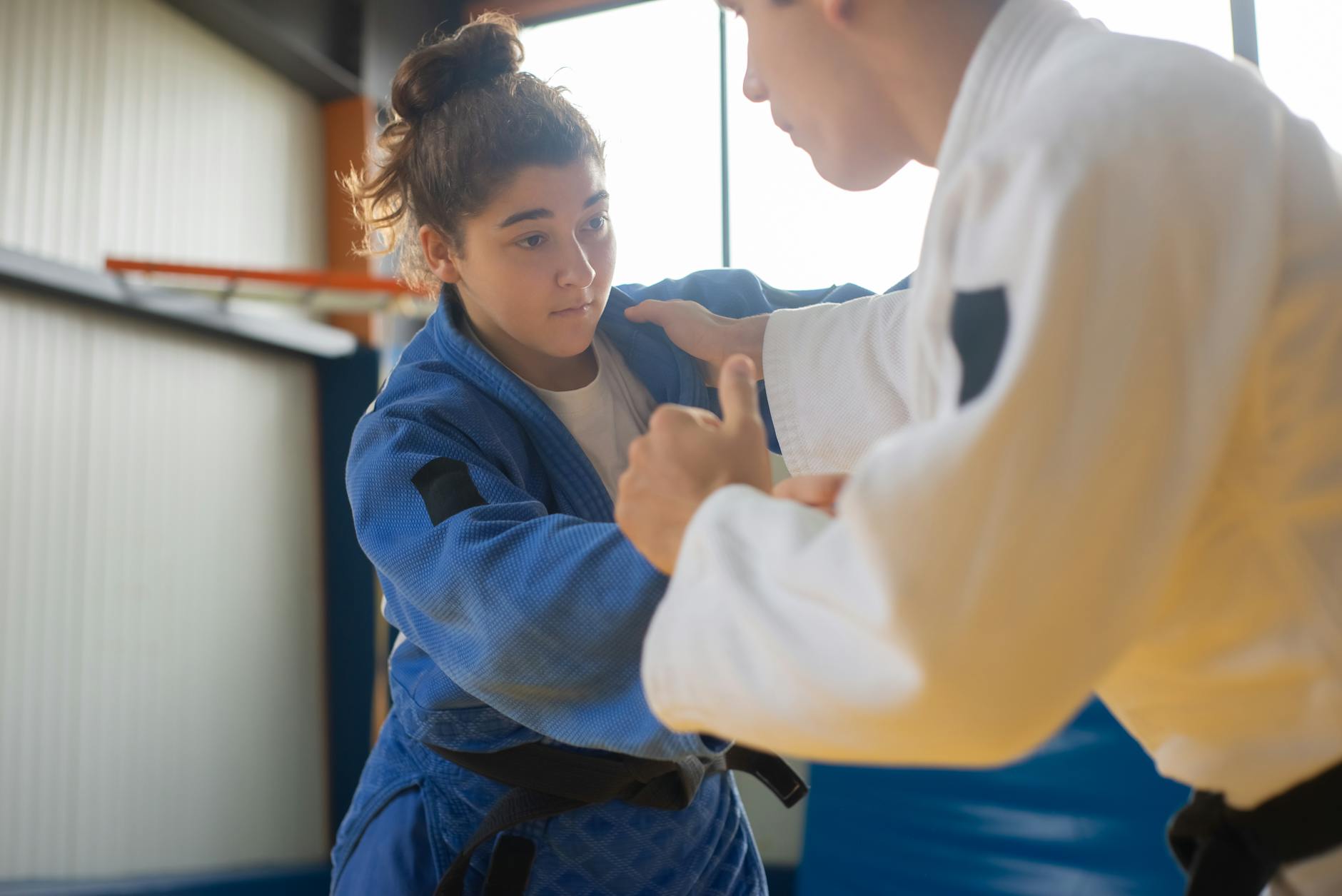
Karate vs. Taekwondo vs. Jiu-Jitsu: Understanding What Each Style Actually Teaches
Before comparing these arts for self-defense, it helps to understand what each one actually focuses on. Karate is a striking art with roots in Okinawa and Japan. It emphasizes punches, open-hand strikes, and kicks, all executed with powerful linear technique. Practitioners build strong stances and learn to generate force efficiently. When people ask “is karate or jiu-jitsu better for self-defense,” they are really asking whether striking or grappling matters more in a real situation.
Taekwondo, a Korean martial art with Olympic recognition, puts heavy emphasis on high, spinning, and jumping kicks. It produces athletes with extraordinary leg speed and flexibility. In a competition context, taekwondo fighters are impressive. In a self-defense context, those same flashy kicks can be hard to land against an unpredictable attacker on uneven terrain. When weighing jiu-jitsu vs. taekwondo for a real fight, the difference in close-range effectiveness is significant.
Brazilian jiu-jitsu (BJJ) focuses almost entirely on grappling, ground control, and submission holds. It was popularized by the IBJJF competition circuit and by early UFC events where smaller BJJ practitioners defeated larger strikers. It is highly effective at controlling an opponent once a fight goes to the ground. The real question is whether reaching the ground is always the best outcome in a self-defense scenario.
Real Confrontations Happen at Close Range
One of the most important facts about real-world self-defense is that most altercations close the distance quickly. You rarely have the space to set up a perfect spinning heel kick. This is where the comparison of karate vs. taekwondo vs. jiu-jitsu for self-defense gets practical. Taekwondo’s strength is distance fighting with long-range kicks, which can be spectacular but depends on range that simply may not exist on a busy sidewalk or in a parking garage.
Karate handles close range better than taekwondo because its arsenal includes short punches, elbow strikes, and knee techniques. Jiu-jitsu is built for close range, using clinches, takedowns, and body control that become available when the gap closes. From a pure self-defense standpoint, an art that assumes distance will be available is at a disadvantage.
This is one reason Kuk Sool stands out as a well-rounded option. It combines striking, joint locks, throws, and pressure-point techniques, addressing multiple distances rather than specializing in just one. According to research highlighted by Harvard Health, physical training that improves both coordination and situational awareness has meaningful benefits beyond athletics, which mirrors what a complete self-defense curriculum actually demands.

Technique Over Size and Strength in Self-Defense Training
A major reason people choose martial arts training over a gym membership is the promise that skill can overcome a size disadvantage. This is a real principle, not just marketing. Jiu-jitsu deserves a lot of credit here. Its leverage-based submissions and positional control mean a smaller, lighter person can neutralize someone much heavier. When parents ask whether karate or jiu-jitsu is better for a child, the answer often depends on what threat scenario they have in mind. For a smaller child needing to escape a larger aggressor, grappling techniques that rely on leverage are genuinely valuable.
Karate also teaches technique over brute force, particularly in traditional styles that emphasize proper mechanics. A well-placed palm strike or wrist lock requires training and precision, not raw muscle. The concern with some competition-oriented karate programs is that sparring rules remove the most practical techniques from regular practice, so students never pressure-test the moves that would matter most.
Taekwondo develops explosive leg strength and reaction time, both of which are real physical assets. But relying on spinning kicks against a larger attacker who grabs your collar requires a level of precision that is hard to execute under stress. Technique matters, and so does whether that technique is realistic under pressure.
Ground Defense and What Happens After the Takedown
Ground defense is one of the most discussed topics in self-defense circles, and for good reason. Statistics on real assaults show that a large percentage of physical altercations end up on the ground. Jiu-jitsu directly addresses this by teaching students to be comfortable and capable when horizontal, whether on top, on the bottom, or working to stand back up.
Karate and taekwondo are primarily stand-up arts. Neither style spends much time on ground defense, which means a practitioner who gets taken down may be at a real disadvantage against someone with even basic grappling experience. In the karate vs. jiu-jitsu debate, this gap in ground training is one of the clearest differences.
That said, jiu-jitsu’s focus on ground fighting can also create its own self-defense blind spots. In a real street situation, going to the ground introduces risks including hard pavement, multiple attackers, and weapons. A self-defense system that addresses stand-up striking, takedown defense, and ground escape as a complete picture, rather than just ground dominance, is arguably more complete. This is a core reason why comprehensive Korean martial arts systems like Kuk Sool train across all those ranges rather than specializing in just one.
Pressure-Tested Training Builds Real Confidence
One of the most honest questions to ask about any martial art is whether students actually practice the techniques against a resisting partner. Drilling a move against a compliant partner is necessary for learning the mechanics, but it does not prepare you for the chaos of a real confrontation. This is where pressure-tested training separates practical self-defense systems from choreography.
BJJ has a strong culture of live rolling, meaning students grapple against partners who are genuinely trying to resist and submit them. This builds real competence under stress. Many karate schools also include full-contact kumite or continuous sparring, which provides genuine pressure. Taekwondo competition is high-speed and physically demanding, though the rules that protect competitors can limit how applicable the trained responses are outside the ring.
The Black Belt Magazine community has discussed this principle for decades: a martial art’s effectiveness in self-defense correlates strongly with how often students actually train against resistance. Whatever style you choose, look for a school where live practice is a regular part of class, not a rare special event.
At a martial arts school for character development like Dragon Mu Sool, this philosophy extends beyond physical technique. Master Nathan’s program emphasizes that genuine confidence comes from honest, consistent training. Students learn to stay calm under pressure because they have practiced staying calm under pressure, not because they were simply told they are capable.
Self-Defense Confidence That Extends Beyond the Training Floor
One thing that surprises many new students is how much of self-defense is mental. Awareness, de-escalation, and the confidence to set boundaries clearly can prevent a confrontation from reaching a physical level at all. This is an area where martial arts training at a quality school provides real-world value that pure sport competition does not always develop.
Students at well-run dojos report that consistent training changes how they carry themselves. There is less anxiety in uncomfortable situations, better eye contact, and a calmer reaction under social pressure. These outcomes show up in children’s behavior at school, in adults’ demeanor at work, and in how both groups handle conflict before it ever becomes physical. The AAP notes on AAP HealthyChildren that structured physical activity paired with character-focused instruction supports healthy social and emotional development in children, which aligns directly with what family-oriented martial arts programs deliver.
Whether you are weighing taekwondo or jiu-jitsu for a five-year-old, or comparing karate vs. jiu-jitsu as an adult beginner, the culture of the school matters as much as the curriculum. A program that pairs solid technique with consistent mentorship on respect, discipline, and inner strength produces students who are safer, more grounded, and genuinely better equipped for life.
Which Martial Art for Self-Defense Is Right for You or Your Child?
So when it comes to comparing karate, taekwondo, and jiu-jitsu for self-defense, here is a practical summary:
- Karate develops strong striking fundamentals and discipline. Best when taught with live sparring and practical application. Can leave gaps in ground defense.
- Taekwondo builds speed, flexibility, and athletic confidence. Excellent for sport and fitness. Less practical at close range or on the ground.
- Jiu-jitsu provides proven grappling skills and leverage-based control. Excellent for one-on-one scenarios. Ground-centric focus may create other vulnerabilities in a street context.
- Comprehensive Korean martial arts like Kuk Sool address striking, joint locks, throws, and ground defense together. This multi-range approach trains students to handle the unpredictable nature of real self-defense situations.
For parents asking whether karate or jiu-jitsu is better for a young child, the honest answer is that the school’s environment and instructor quality matter more than the style label at that age. What a five-year-old needs is structured movement, positive reinforcement, basic awareness, and a teacher who genuinely invests in their development.
If you want your child or yourself to train in a proven Korean martial art that covers real self-defense from standing to ground, while building the character habits that make the whole skill set meaningful, we invite you to visit Dragon Mu Sool and see what Master Nathan’s program is all about. Take the first step and contact us today for a free trial class and experience firsthand why so many families keep coming back to this community.